Authors: Catherine Ragasa, Opeyemi Olanrewaju, Oliver. K. Kirui, Pwagalari Bwato, and Mariam Ajadee
Nigeria's smallholder farmers face a difficult mix: unpredictable weather, volatile markets, rising input costs, and an extension service that cannot reach everyone. Digital platforms promise to help close that gap, delivering advice, prices and weather information faster and further than conventional extension can. But do they deliver, and for whom?
On 27 August 2026, IFPRI convened a dissemination and policy dialogue in Abuja, bringing together about 40 stakeholders from government, development partners, agritech firms, research institutions, CSOs and farmers' groups. The dialogue examined the evidence on digital agricultural advisory in Nigeria, focusing on Crop2Cash, one of the country's leading platforms, and weighed it against comparable initiatives in Nepal and Pakistan.
Oliver Kirui, IFPRI's Country Program Leader for Nigeria, set a grounded tone. "The question is no longer whether it can be done," he said. "The more important questions are: for whom, can they reach farmers at scale, can they be financially and institutionally sustainable, and should they complement rather than operate separately from the public extension system?" IFPRI's role, he added, "is not to provide digitalization for its own sake, but to generate rigorous evidence on what works, for whom, and under what conditions."
Delivering the chief guest's remarks, Eng. Dr. Tehinse S. Taiye, Director of Agricultural Extension Services at the Federal Ministry of Agriculture and Food Security, put the stakes plainly: "Agricultural extension is the critical link between research innovations and the farmer." Digital tools have an important role, he said, but only if they join a coordinated national system rather than adding to a set of isolated initiatives.
Meeting farmers where they are
Babafemi Adewumi, Business Development Manager at Crop2Cash, described what it takes to run a digital advisory service in Nigeria. The starting point is the farmer's phone, not the app. "Let's get to meet farmers where they are, not bringing them to where we are." Crop2Cash builds around SMS, voice, an AI-powered toll-free hotline and human agents, all in local languages, because language is central to trust: "You understand in your mother language." When the digital channels reach their limit, a person picks up.
That human element, Adewumi said, is what makes the technology work. "Technology scales rapidly, but the human extension agent remains the ultimate anchor for trust building." Farmers often call late into the night: "Most times 10 in the night, 11 in the night, 12, farmers keep calling… they want to talk." None of it is simple to sustain, he acknowledged, given patchy coverage, data costs and the expense of running toll-free lines at scale.
The gains are real — but they come through the market, not the field
Opeyemi Olanrewaju, Research Analyst at IFPRI–Nigeria, presented the institute's evaluation of the Crop2Cash advisory platform. The headline finding was not the one many expected. A quasi-experimental study of more than 1,700 households across three states found the platform's benefits in sales and income, not in physical productivity. Advisory users earned average profits of about ₦987,000, compared with roughly ₦776,000 for non-users. "The improved profits flow through the markets and quality, not through productivity," he reported.
Yields barely moved. "Only 13% of them cite improved production as a benefit," Olanrewaju noted, a sign that information alone does not lift productivity when farmers lack the finance, labour, inputs and infrastructure to act on it. The results also carried an equity signal. The lowest-asset farmers showed the strongest returns, but women did not: "About 30% of advised users are women, with no clear gains. Structural and cultural barriers exist."
Context is everything: lessons from Nepal and Pakistan Catherine Ragasa (Senior Research Fellow, IFPRI, Washington DC) broadened the picture, comparing Crop2Cash in Nigeria with Geo Krishi in Nepal and BKK in Pakistan.
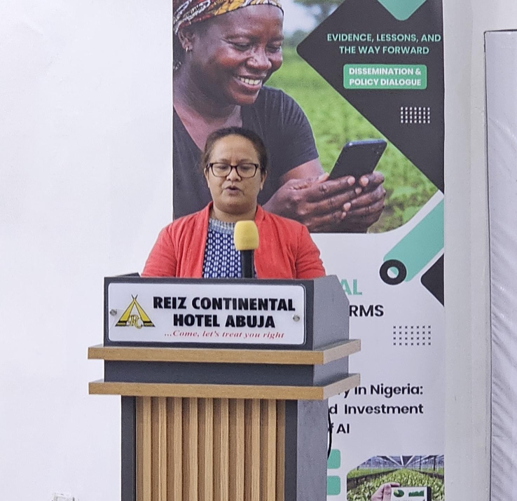
The same kind of technology produced very different results depending on where farmers started. "In Nepal, we see huge gains in productivity because they are starting from a low base," she said, helped by validated content and agripreneurs who kept farmers engaged. Nigeria and Pakistan, already more commercialised, saw sales rise without an overall change in yield, though crops like sorghum, millet and sesame gained. The consistent thread was complementarity: "The digital helped to increase productivity, but it was the human agent that made the sales income gains."
Two harder questions ran through her presentation. The first was honesty about reach: "There's a large gap in terms of registered and active users… If I say I reached 20 million, who is going to check?" Crop2Cash's 300,000-plus registrations, she noted, sit against a far smaller active base. The second was the tension between sustainability and integrity. As subscriptions falter, platforms increasingly use advice "as a hook or a bonus for farmers to buy inputs," which risks pushing recommendations toward "more inorganic fertilizer and hybrids" rather than what serves the farmer best.
Scaling digital agricultural advisory in the age of AI
The first panel, chaired by Archie Stay of the British High Commission, with Hardwick Tchale (World Bank), Olorunnisola Alagbe (Crop2Cash), Yusuf Dollah (HarvestPlus Solutions) and Bunmi Ogunleye (IFAD), returned repeatedly to a basic constraint: you cannot talk about scale without patchy connectivity, data costs and limited smartphone ownership. That explained the enthusiasm for low-tech channels, and the caution against a flood of disconnected apps that one panellist likened to "a junkyard for solutions applications." A voice AI running on a simple USSD code was singled out as a breakthrough for farmers with no smartphone and no data.
AI drew the closest scrutiny, because its usefulness depends on the knowledge behind it. "Personally, I do not support any AI that is not institutionally driven," Ogunleye argued. "It needs validated messages, local content, and human interaction." That pointed to a structural weakness: a broken feedback loop, where "feedback is not sent back to research institutions so that information can be updated." The panel saw public and private actors as complementary rather than rival and cautioned against equating scale with headcount. Sustainable scale means solutions that fit farmers' circumstances, not simply more registrations.
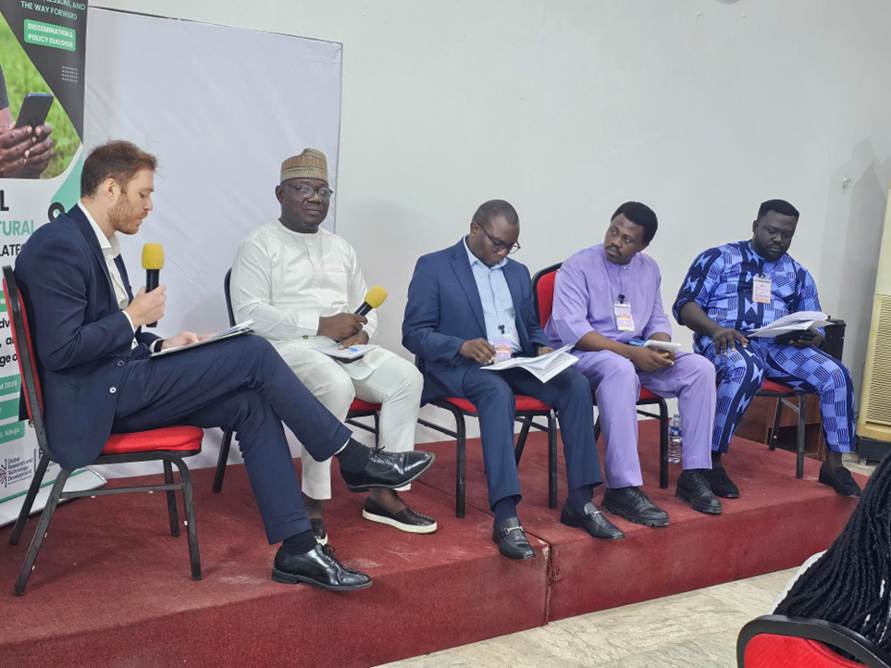
Cross-section of panelist chaired by Archie stay (British High Commission), at the Policy dialogue, Abuja, Nigeria.
From pilots to sustainability – Business Models, Bundled Services and Inclusion
The second panel, chaired by Dr. Bashir Gwandu on behalf of Dr Adamu Abubakar (Executive Secretary, Agricultural Research Council of Nigeria), with Kamaldeen Raji (AFEX Commodity), Babafemi Adewumi (Crop2Cash) and David Edimu (Digital Green), turned to the question of financing. Since subscriptions do not work for most smallholders, platforms bundle advice with input sales, finance and insurance. Edimu set out the logic: "The value proposition is getting advisory from this platform… but after you have them secured, how do I bring in the supplier?… how to monetize these other services."
The counterweight, the panel argued, is to design for the whole ecosystem. "We must plan for the ecosystem… solve for storage, for market access," one panellist urged. Raji made the same point from the farmer's side: "What are you solving for?… These farmers are not just producing for you, they are producing for themselves." The panel favoured hybrid models with physical presence, digital tools, feedback loops and protective services like credit and storage, and returned to the basics that make everything else work: "Farmer registry is very important. Data infrastructure, very important. Digital literacy training is very important."
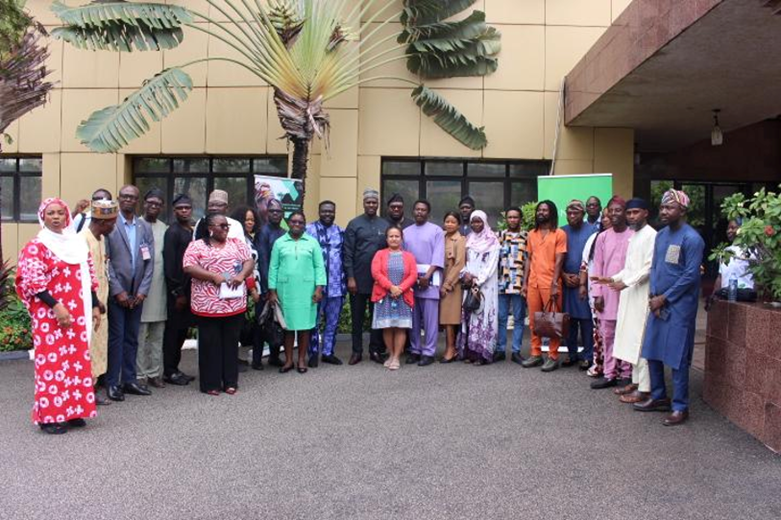
Cross-section of participant at the Policy dialogue, Abuja, Nigeria
Key lessons and the way forward
A few clear lessons cut across the day:
- Digital should strengthen extension, not replace it. Human agents — Nepal's agripreneurs, Crop2Cash's hotline staff — remain essential for the trust and follow-up that keep farmers engaged.
- The gains run through the market, not the field. Better prices, post-harvest advice and buyer connections drove the returns, not higher yields — and information alone will not lift productivity without finance, inputs and markets to act on it.
- Context is decisive, and access is not the same as benefit. Outcomes shifted across Nepal, Pakistan and Nigeria, and women and poorer farmers can use a platform without gaining from it, so inclusion has to be designed in.
- Close the research–extension–platform loop and protect advisory integrity. Advice is only as good as the validated knowledge behind it — a gap AI makes sharper — so safeguards matter.
- Registered users are not active users. Credible comparison and investment depend on transparent measures of who is really using the service.
In the end, these services should be judged not by how many farmers register, but by whether they act on the advice and are better off for it.