Near the end of 2022, the Central Bank of Nigeria began withdrawing old Naira notes from circulation as part of a redesign of the currency. With the slow distribution of new notes, Nigeria experienced a cash shortage. Between December 2022 and January 2023, the amount of currency in circulation fell by nearly 2 trillion Naira. During this time, non-cash alternatives grew in popularity. According to the 2025 Findex data, the share of adults in Nigeria reporting that they have an account at a bank or similar financial institution or used a mobile money service increased from 45 percent in 2021 to 63 percent in 2024. Moreover, point of sale (POS) machines can be found at nearly any market, kiosk or roadside stall.
Still constraints on the use of digital payment systems persist. Not only is the use of a digital financial account not universal in Nigeria and lagging behind many other low- and middle-income countries, but use of these accounts skews heavily towards men and the wealthiest 60 percent of the population, according to the 2025 Findex data.
It is within this environment that we are currently beginning the process of collecting a new round of survey data that aims to track digital financial service access and use within the intermediary segments of selected agri-food value chains. Agri-food value chains are the backbone of food systems and economies worldwide. In Nigeria's agricultural landscape, the journey from farm to table relies heavily on often-overlooked "midstream" actors - aggregators/traders, processors, wholesalers, and off-takers. These intermediaries ensure reliable access to food for consumers, create non-farm employment opportunities, and generate export revenue. Yet their needs are either neglected, poorly understood, or largely understudied.
Previous research in Uganda and Bangladesh revealed that these intermediary actors operating within agri-food value chains face many financial needs and almost exclusively conduct their business with cash payments. This dependence on cash payments generates challenges such as high cash-handling risks, slow payments, limited access to formal credit, and logistical hurdles. In principle, digital financial services promise tangible solutions such as faster, safer, and more traceable transactions that can unlock financing opportunities and improve efficiency. Despite these potential benefits, adoption lags, especially for business use.
Our current study aims generate survey evidence to examine the real constraints to digital payment adoption among these important intermediary actors in Nigeria's agri-food value chains, specifically focusing on the rice value chain in Kano State and the aquaculture value chain in Delta State. Unlike traditional agricultural surveys that focus solely on farm households, we use a sampling approach designed to characterize the structure and scale of these value chains. Specifically, we use the network-driven sampling approach developed in our previous round of surveys to identify intermediary actors via their transaction-linked network.
The sampling process starts small, with farmers. We randomly select villages in target districts and interview farmers about their recent sales, specifically enumerating referrals to sales links. These referrals build our database of intermediary actors. We then contact and interview those aggregators/traders, processors, or wholesalers, recording their own sales links to further populate our referral database. This iterative data collection process continues, ensuring respondents are genuinely connected to the value chain and that it reflects its complex nature.
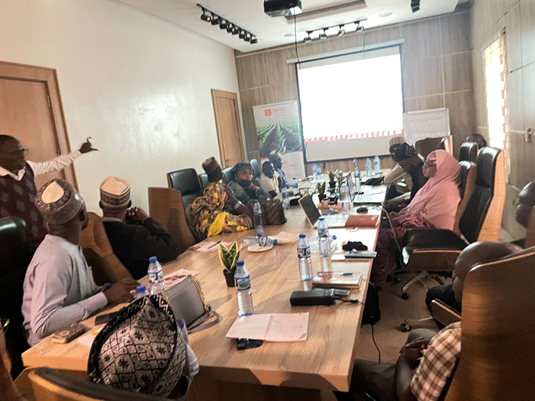
Our team kicked off an intensive 5-day training in Kano State (pictured above) and Delta State, led by a local consulting firm. The 36 participants (24 men and 12 women) engaged in in-depth discussions about the motivation of the study, survey techniques, and ethical protocols. They conducted a module-by-module walkthrough of the questionnaire, engaged in role-playing activities, and finalized field logistics before implementing a full pilot test of the survey. The survey itself is still ongoing, with field teams now actively collecting data across the targeted areas.
As digital finance evolves, understanding barriers and opportunities relevant to intermediary actors is important to building inclusive agri-food systems in Nigeria. Our findings will highlight financial needs, inform policy, and guide innovations that can shift Nigeria’s economy away from cash-dependence, with the potential to benefit the entire food system, from farmers to consumers.
Authors: Temilolu Bamiwuye and Jeffrey R. Bloem