Good policies depend on good data. When governments and development partners design youth employment programs, social protection schemes, or education investments, they rely on evidence about how young people actually live, work, study, and move. If the data is incomplete, biased, or poorly collected, the resulting policies can miss their targets, and scarce resources may be misallocated.
The International Food Policy Research Institute (IFPRI) recently launched a Longitudinal Youth Cohort Study to understand the livelihood trajectories of young women and men aged 15–35 in northern Nigeria. Northern Nigeria presents a dynamic context in which insecurity and limited opportunities drive youth mobility, making the region challenging. The study is designed not only to produce high-quality evidence for policy formulation, programmatic advice, and investment prioritization, but also to strengthen local capacity for rigorous data collection and analysis.
For the first wave of data collection, IFPRI organized intensive training from September to October 2025 across four states—Adamawa, Jigawa, Kano, and Sokoto. The study used two structured questionnaires—one administered to the household head for household-level information, and another administered to youth aged 15–35 within the same household. This effort supported successful data collection from approximately 3,200 youth across 168 communities, creating one of northern Nigeria’s most comprehensive datasets on youth livelihoods. For IFPRI and its partners, this baseline is an important first step toward tracking how young people navigate work, education, mobility, and opportunity in a rapidly changing environment. The path to this achievement, however, involved careful attention to sampling, field protocols, and data quality processes, as well as deliberate investment in a new generation of young enumerators and future researchers.
From Sampling Design to Field Reality
Before any questionnaire reaches the field, decisions about sampling, who is included, which communities are selected, and how respondents are chosen within them determine how far the findings can be generalized. For this study, youth were sampled from 168 communities across the four states to reflect diverse social, economic, and security contexts. Initially, we planned to randomly select an equal number of communities from each state. However, the review of the household listing data showed that some communities were duplicated under different names. They were cleaned, and 168 unique communities were randomly selected across the four states.
During the training, enumerators were not just handed lists of respondents; they were walked through the logic of the sampling design and the importance of following it precisely. This meant understanding why substitutions are not allowed, how to handle absent respondents, and how to document refusals or incomplete interviews. By grounding enumerators in the “why” behind the sampling, not just the “how,” the training helped build a mindset that sees each interview as part of a larger evidence system that policymakers will eventually rely on.
Building Core Competencies
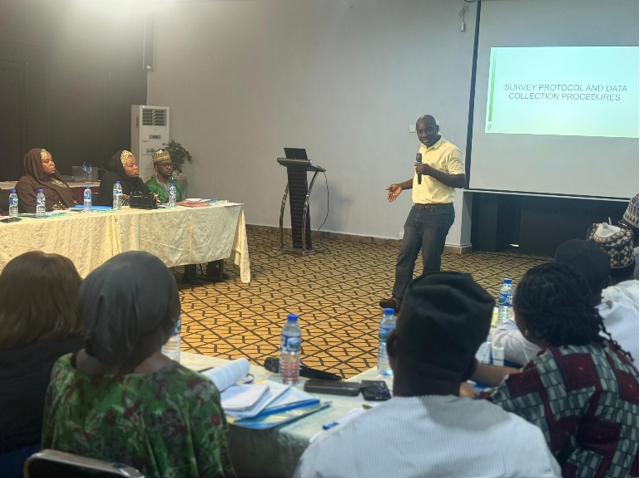
IFPRI organized a six-day intensive training session in each of the four selected states, with 20 male and female enumerators selected from local communities in attendance in each location. The training focused on equipping them to administer both household and individual questionnaires effectively and consistently, while safeguarding respondent well-being and data integrity.
The curriculum covered eight core competencies, including research ethics and human subjects protection; Computer-Assisted Personal Interviewing (CAPI) using SurveyCTO, a mobile platform widely used for research and monitoring and evaluation; professional interviewing techniques for sensitive modules; gender-matched fieldwork protocols; security protocols for conflict-affected areas; quality assurance systems; and detailed module-specific instruction. The modules spanned education, employment, financial inclusion, migration, health, mental health, civic engagement, time use, climate change, and aspirations. As many enumerators later noted, the training was not only technically useful but also personally relevant, helping them reflect on their own experiences and those of their peers.
At the beginning of the training, the team assessed enumerators’ existing competencies and found that most were already familiar with electronic data collection tools. The training therefore served as both a refresher and an opportunity to deepen skills, strengthening their confidence and consistency in using SurveyCTO. Beyond technical proficiency, the training emphasized interpersonal skills that are especially important in northern Nigeria, where young respondents may initially feel uneasy about structured questions or topics that challenge social norms. Through repeated role-play exercises, enumerators practiced building rapport, obtaining informed consent, and navigating sensitive topics with empathy and patience.
The training also included a dedicated security module, facilitated by a security expert, in response to ongoing insecurity in parts of northern Nigeria. Enumerators were briefed on risk assessment, safe movement, and conflict-sensitive behavior, recognizing that entering communities as outsiders can raise concerns. These sessions were crucial in preparing teams for the realities of fieldwork, where cultural sensitivity, situational awareness, and sound judgement are just as important as understanding the questionnaire.
Refining Tools and Techniques Through Discussion
Classroom discussions played a key role in improving both the questionnaire and the way it was administered. Some modules, especially those related to family formation and risky behaviors, sparked important conversations. During the family formation module, for example, enumerators who live in the sampled communities expressed concern about asking women questions about sexual experience or men about alcohol or cigarette use. They emphasized that such topics are highly sensitive in northern Nigeria, even with gender-matched interviewing in place, and that the way questions are introduced matters for both respondent comfort and data accuracy.
These exchanges helped the team refine the wording, sequencing, and introductory scripts for sensitive questions while reaffirming that female respondents would be interviewed by female enumerators and male respondents by male enumerators. This kind of open dialogue is an example of “pre-analysis thinking”: anticipating where respondents might be uncomfortable or misunderstand questions and adjusting the instrument before large-scale data collection begins.
Enumerators also contributed critical feedback that improved specific modules. In the financial inclusion section, they pointed out that under Nigerian law, youth under 18 cannot open bank accounts in their own name, affecting how questions on formal financial access should be interpreted. They also noted that while English is officially the medium of instruction, many rural schools supplement teaching with Hausa to aid understanding, influencing how education questions should be framed. Concerns about how respondents would interpret Likert-scale questions prompted the team to revise phrasing to make response options clearer and more intuitive.
These discussions were not just about polishing the questionnaire for this wave of data collection. They were part of a broader process of mentoring young enumerators to think like researchers: questioning assumptions, drawing on local knowledge, and considering how the wording of a question can shape the data that analysts and policymakers will eventually see.
The Field Pretest
Following the classroom sessions, a field pretest was conducted to assess skills and knowledge, evaluate the functionality of the survey tool, and build enumerators’ confidence before full rollout. The pretest took place on the sixth day in locations different from the sampled youth communities, to avoid contamination of the main study. The selected sites were contextually similar but geographically distinct from the actual survey areas.
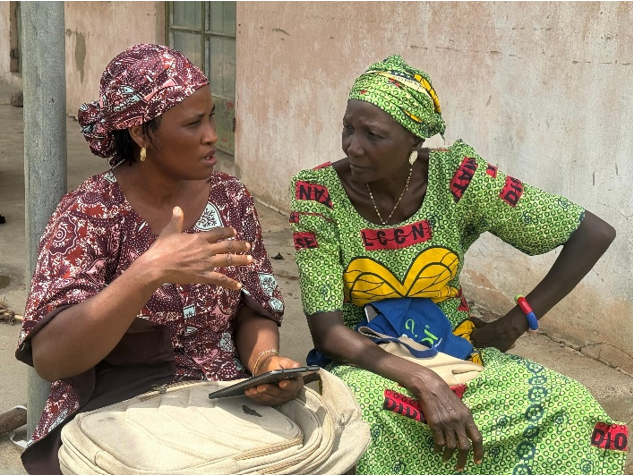
The pretest was conducted in local primary schools across the four states, where eligible respondents participated. The open environment provided a realistic simulation of data collection, including respondent identification, time management, privacy protection, and engagement with youth in a semi-public setting. Enumerators approached potential respondents in open spaces, then moved with each respondent to a quiet, private area for the interview. Although controlled, the pretest offered a valuable glimpse into field dynamics, power relations, and the practical challenges of maintaining privacy and confidentiality in busy community settings.
Findings from the pretest informed adjustments to skip patterns and interview flow within the digital questionnaire. The exercise allowed the team to estimate interview duration more accurately and identify modules or questions that were overly long, confusing, or repetitive. It also exposed the team to scenarios that had not been anticipated in the initial planning, leading to improvements in response options, enumerator instructions, and module structure. In effect, the pretest served as an early stage of data cleaning and pre-analysis, revealing where the instrument might generate messy, inconsistent, or incomplete data if left unchanged.
Skills Growth, Data Quality, and Team Cohesion
By the end of the training and pretest, enumerators demonstrated strengthened technical proficiency, improved interviewing techniques, and a shared commitment to data quality. They were more confident using SurveyCTO, more skilled in handling sensitive youth-focused modules, and more aware of how their day-to-day decisions in the field would shape the final dataset.
The training also encouraged enumerators to see themselves not just as data collectors but as part of a longer-term research ecosystem. Many expressed interests in learning more about how the data would be cleaned, analyzed, and used to inform policy. This presents an important opportunity: building a pipeline of young Nigerian researchers who understand the full cycle—from sampling and questionnaire design through data collection, cleaning, and pre-analysis, to eventual policy use. In future waves of the study, some enumerators may transition into roles supporting data quality checks, basic analysis, or local dissemination, further strengthening local ownership of the evidence
Lessons Learned: Investing in Quality and Capacity
The training generated several important lessons for future large-scale data collection in rural northern Nigeria. First, combining technical instruction with practical, scenario-based learning is essential for equipping enumerators to manage complex, multi-module questionnaires and the sensitivities of youth-focused interviews. Training that links sampling protocols, ethical guidelines, and real-life field scenarios helps enumerators not only to “follow instructions” but also understand the consequences of shortcuts for data quality and policy relevance.
Second, early and open dialogue with enumerators, especially those from the study areas, proved invaluable for identifying culturally inappropriate questions, refining gender-matching protocols, and adjusting modules to better reflect local realities. Their insights prevented potential non-response, misreporting, and discomfort that could have compromised the data and its usefulness for decision-makers.
Third, the pretest underscored the importance of validating survey flow, timing, and privacy procedures in environments that resemble actual field conditions. Doing so helps reveal unanticipated challenges before large-scale implementation and serves as an early “stress test” for data quality. In effect, pretesting is a form of pre-analysis: it helps anticipate where the data will be noisy, where enumerators may struggle, and where respondents may be confused.
Finally, this experience highlights that high-quality survey implementation depends not only on strong tools and well-designed questionnaires, but also on sustained investment in people. Training young enumerators in research ethics, sampling, digital data collection, and problem-solving is an investment in the next generation of analysts, policymakers, and data champions. As Nigeria and its partners seek to design better policies, better programs, and smarter investments for youth, building this human capital for data collection and analysis will be just as important as any single survey round or dataset.
Authors: Adetunji Fasoranti, Olufemi Popoola, Chibuzo Nwagboso, Oliver Kirui, Temilolu Bamiwuye, Kalyani Raghunathan, Jessica Heckert.