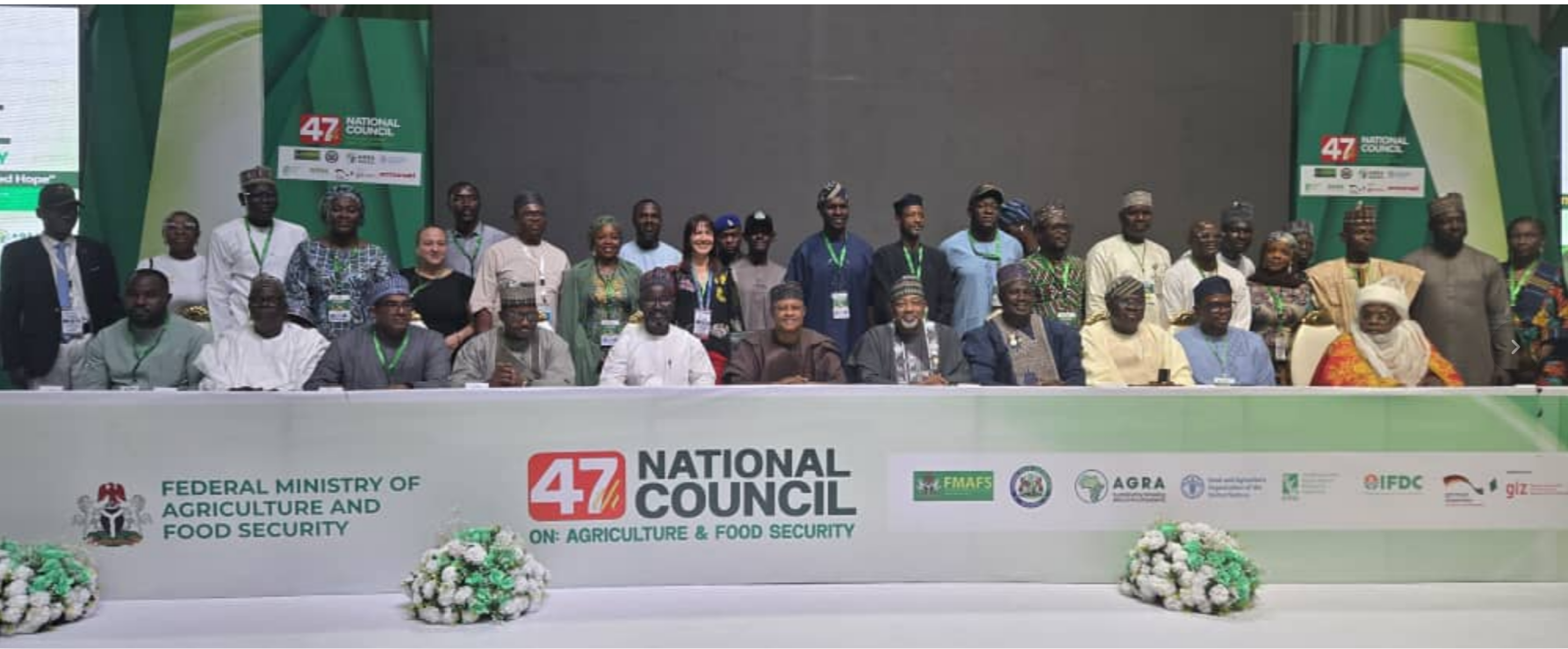
The future of Nigeria’s food system transformation gained momentum at the 47th National Council on Agriculture and Food Security (NCAFS), held in Kaduna. This high-level forum convened key actors – including the Honorable Minister and State Minister of Agriculture, Permanent Secretary, commissioners from all 36 states, development partners, private sector leaders, and civil society organizations – to shape policies aimed at achieving food sovereignty and long-term sustainability.
Discussions centered on critical themes: soil health, climate resilience, digital innovation, youth engagement, market integration, post-harvest management, and agricultural finance. These are bold priorities, urgently needed to transform Nigeria’s food systems amidst growing local and global challenges.
The Challenge: Persistent Risks and Policy Gaps
Nigeria’s food sector continues to face structural threats: climate change, insecurity, low productivity, outdated subsidy schemes (such as the Anchor Borrowers’ Programme and Agro-Pocket), and chronic inefficiencies in post-harvest handling. These problems are compounded by fragmented supply chains, poor infrastructure, and soaring food prices – leaving an estimated 31 million Nigerians food-insecure.
In response, the Federal Ministry of Agriculture and Food Security (FMAFS) and the Presidential Food Systems Coordinating Unit (PFSCU) have proposed strategic initiatives, including climate-smart agriculture and integrated value chains aligned with the Comprehensive African Agriculture Development Programme (CAADP). While CAADP calls for 10% of national budgets and 6% agricultural growth annually, Nigeria’s agricultural spending remains below 2%. Meanwhile, implementation continues to suffer from bureaucratic fragmentation and underfunding. This widening gap between policy and practice weakens national food security and hinders true food sovereignty.
The Opportunity: A Stakeholder-Informed Theory of Change
Despite these setbacks, Nigeria has an opportunity to realign strategy through a stakeholder-informed Theory of Change (TOC) – a roadmap linking evidence, policy, and action. A well-developed TOC translates high-level ambitions into measurable, achievable outcomes grounded in real-world challenges. It serves as a strategic tool to:
- Guide programming and investment
- Track progress toward goals like CAADP and SDG 2 (Zero Hunger)
- Enhance accountability and transparency
- Foster collaboration among research institutions, government agencies, and development partners
Crucially, this approach involves farmers, traders, and local governments – not just federal policymakers – giving communities a voice in shaping the transformation agenda.
As Dr. Oliver Kirui, IFPRI-Nigeria’s Country Program Lead, emphasized at the 47th NCAFS:

“A national Theory of Change strengthens coherence across research, policy, and action. It connects strategies to measurable impact – by 2030 and beyond.”
Why a National Theory of Change Matters
The NCAFS remains Nigeria’s highest agricultural decision-making body. By integrating TOC development into its processes, the Council strengthens linkages between national policies and grassroots realities. This counters past failures of top-down planning and reinforces trust between government and stakeholders.
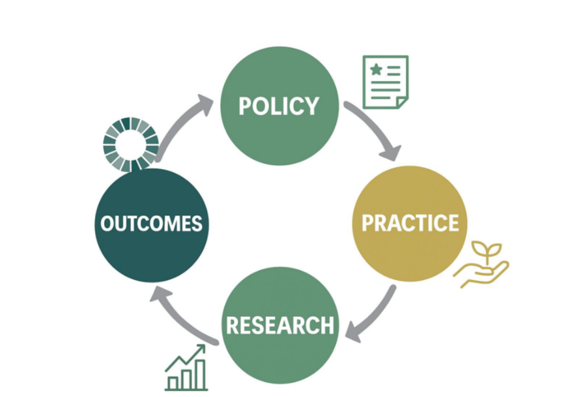
Three Pathways for Food System Transformation
To operationalize the Theory of Change, Nigeria must activate three interconnected pathways:
- Evidence to Policy
This pathway ensures that research directly informs agricultural policymaking. Institutions like IFPRI and CGIAR, in partnership with FMAFS, PFSCU, and the National Bureau of Statistics, offer analytics, foresight modeling, and rapid diagnostics. These tools guide investment decisions aligned with national development priorities and CAADP targets – strengthening data-driven governance.
- Policy to Practice
This pathway connects policies to implementation by supporting subnational planning, improving institutional capacity, and fostering coordination across ministries (agriculture, trade, environment, finance). Stakeholder-informed TOCs enable gender- and youth-responsive programming and ensure that recommendations are embedded into on-the-ground programs.
- Partnerships and Collaboration
No transformation can happen in isolation. This pathway prioritizes cross-sector partnerships between government, the private sector, and development actors. Joint efforts can build innovation agendas, strengthen ownership of national data systems, and create feedback loops for continuous learning and improvement.
Localizing the TOC: State, Community, and Private Sector Roles
- At the state level, platforms like the Nigeria Governors’ Forum and Agriculture Commissioners can localize the TOC to align regional strategies with national goals.
- At the community level, farmer cooperatives – especially women and youth-led groups – can co-create grassroots TOCs, identifying priorities and customizing solutions to local needs.
- The private sector, including agro-processors and logistics innovators, can invest in scaling solutions such as solar-powered storage or mobile advisory services. Training hubs and innovation platforms can further enhance TOC refinement and adoption.
Conclusion: From Blueprint to Breakthrough
Nigeria’s agricultural journey reflects both bold ambitions and structural missteps. Yet the country stands at a turning point. The renewed federal commitment to food sovereignty and CAADP principles, when coupled with an inclusive, stakeholder-driven Theory of Change, offers a viable path forward.
These co-designed TOCs represent more than planning tools. They are instruments of transformation, grounding national policies in local realities and converting intent into impact. With coordinated effort, Nigeria can move beyond crisis response – toward a resilient, sovereign, and sustainable food future built from the ground up.
Authors: Oliver. K. Kirui; Opeyemi Olanrewaju; Hyacinth Edeh; Amina Bashir-Yakubu